Latest bucket · B BucketCase 04030009Published 03/30/2026, 14:00
Open original videoHook Type:Character-label hook + school magic-performance hook
Hey bro, want to see a magic trick? 😅🌀
Original title:Oye Ek Jaadu Dikhau 😅🌀!! #shorts #viralvideos #funnyvideo #relatable
Channel
Aryan S07
Views
30,725,702
Likes
267,449
Comments
373
[A highly familiar school archetype] + [direct speech that establishes the role immediately] + [classmates who ask, react, and gather around] + [a sequence of low-cost hand tricks] + [an overconfident performer attitude] = a memory-driven campus Shorts formula
This clip is not built around a big reversal. It is a character-based school comedy about that one boy who is always doing magic tricks in class or during break. The opening uses direct speech and on-screen text to lock the archetype in immediately, so the viewer knows right away they are watching a familiar school character, not a complicated plot setup. From there, the humor comes from how seriously he sells every tiny trick. He talks like a confident mini performer, keeps classmates engaged, and turns low-cost thumb, cloth, and hand tricks into a full social moment. What makes the video work is not the technical difficulty of the magic. It is his overconfident, dead-serious performer energy, plus the fact that classmates actually gather around and play along. The spreadable part is the memory trigger: every school seems to have that one boy who can control a small crowd with basic tricks and a lot of confidence.
Market
Indian school-life comedy context
Language type
Heavy dialogue
Estimated RPM
USD 0.01 - 0.03 per thousand views (Shorts local campus comedy / character sketch, conservative estimate)
Emotion curve
Character recognitionCuriosityListening to him sell the trickWatching the hands closelyMild surpriseMore classmates joinHe keeps performingThe archetype lands as the final joke
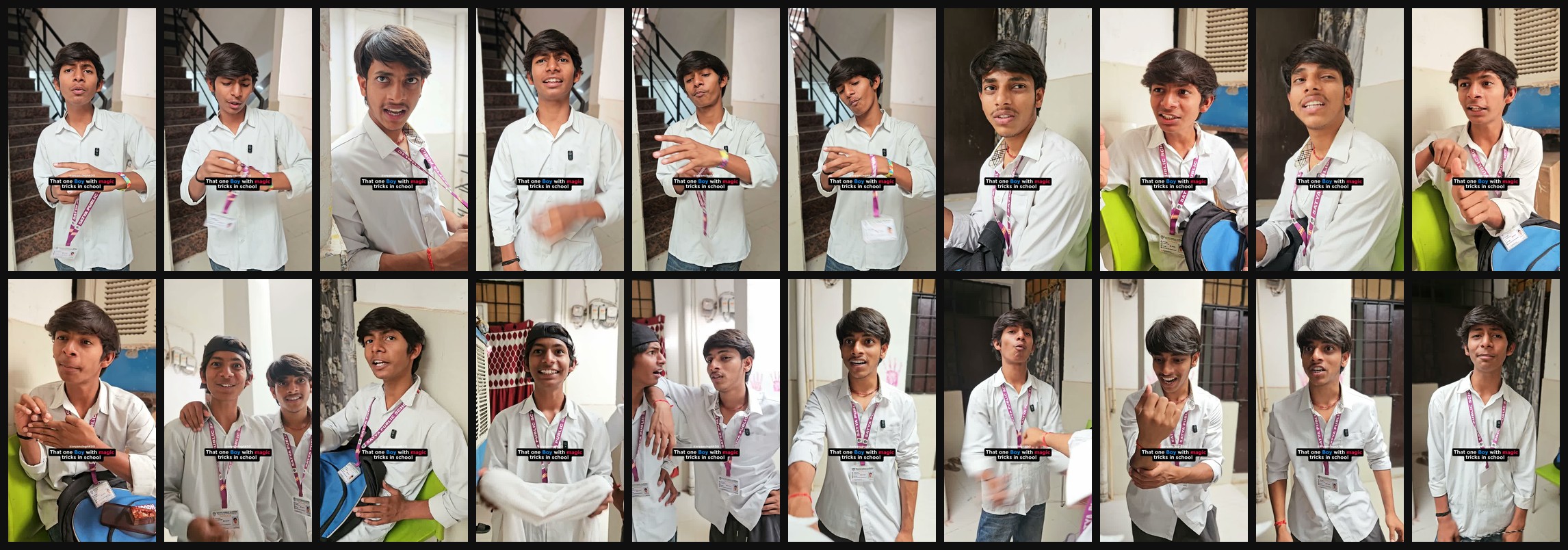
Contact sheet
Contact sheet
0-3 seconds
0-3s opening hook
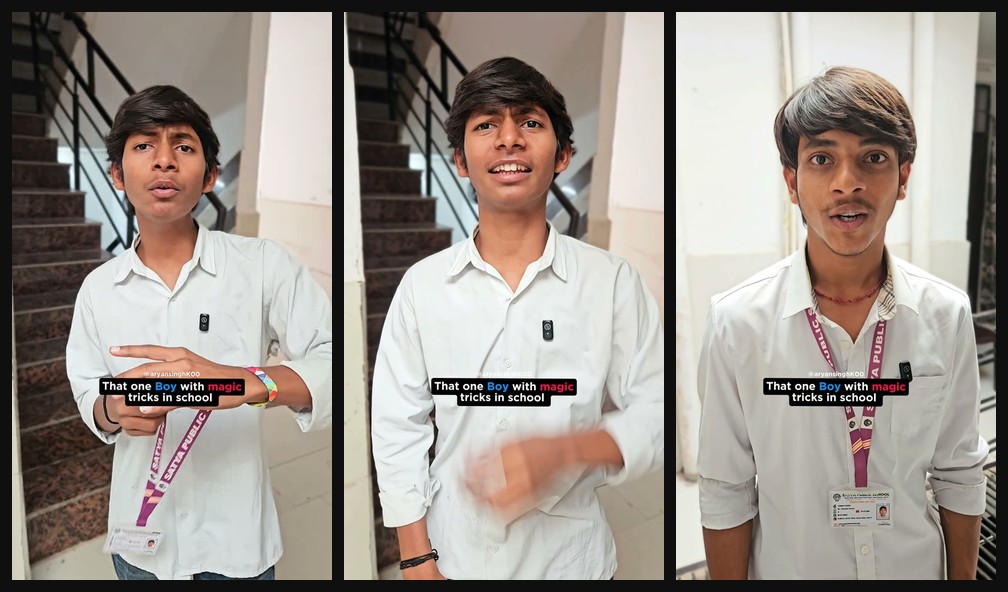
The opening does not rely on conflict first. It labels the archetype immediately: the boy in school who does magic tricks. That makes entry very fast because viewers already know this type of person.
The protagonist starts in a close talking shot, with matching hand gestures and text, so the audience instantly reads him as someone preparing to show off a trick.
This kind of hook works through recognition rather than suspense. The audience is not waiting for a complex ending. They are waiting to see how this familiar character will act next.
For Shorts, this label-first opening is efficient because it compresses the understanding cost into the first few seconds.
Density
Viral density
Turning points
The on-screen text establishes the school-magic-boy archetype
The protagonist takes control with direct speech and performer attitude
Another student asks to be taught and enters the interaction
He actively offers to show a magic trick
The thumb trick locks the viewer onto his hands
A cap-wearing classmate helps create a crowd atmosphere
The white cloth prop adds a stronger performance feel
The clip ends with the protagonist still acting like he fully owns the room
Core conflict
The tension is not a standard external conflict. It comes from the comic gap between how seriously the protagonist presents very basic tricks and how willingly the classmates lean in, react, and let him own the social space.
Ending design
The clip does not need a big reversal because the product being sold is the character archetype itself. Letting him keep the same confident performer energy all the way to the end makes the role feel complete and memorable.
Edit density
Medium-high, driven mainly by expression, hand-detail, and reaction switching. Each shot serves the same purpose: making the `school magic boy` archetype feel more real.
Roles
Roles
Magic boy
The core character of the clip. He is not trying to pull off elite-stage magic. He is playing the schoolboy archetype who always has a trick, always wants attention, and treats basic hand moves like secret-level skills.
Watching classmates
They ask questions, respond, and provide the necessary social feedback. Without them, the protagonist would just be talking to himself. With them, the scene becomes a real campus performance moment.
Cap-wearing classmate
A clearer mid-to-late interaction partner who helps the scene expand from one-on-one banter into a small public demo.
Frame-by-frame
Frame-by-frame
00:00 - 00:06
The clip opens on the boy in close-up while the screen text reads `That one Boy with magic tricks in school`. It is an efficient setup because it gives the audience the character label first, then lets the rest of the clip prove that label.
00:06 - 00:12
The camera moves between the boy and another student while he keeps a tone of `I know how to do this, I can teach you later`. This section is not about plot twist. It is about showing how he uses small talk and confidence to hold attention.
00:12 - 00:18
He actively invites the other student to watch a magic trick and narrows the focus onto his hands. The character shifts from talkative schoolboy into a mini performer, and the audience follows that shift naturally.
00:18 - 00:25
Once he sits down, he starts the thumb-based trick and repeatedly checks whether the other person can see it clearly. The real point is not technical brilliance. It is that he knows how to force people to watch closely.
00:25 - 00:32
The back-and-forth between his explanation, the other student's reaction, and the hand movement turns the clip into a believable school performance moment. That is where the core social pull of the video locks in.
00:32 - 00:39
A cap-wearing classmate becomes a more visible participant, which upgrades the feeling from one-on-one talking into a small crowd gathering around the act.
00:39 - 00:45
A white cloth enters the frame and gives the trick a more ceremonial, stage-like feeling. Even though the prop is simple, his serious face and the classmates' cooperation keep the viewer watching.
00:45 - 00:51
He switches back to another hand-based trick involving a small cord or chain-like prop. By this point, the audience is less focused on whether the trick is real and more focused on his performance persona.
00:51 - 00:57
The ending keeps him in control of the moment rather than giving a big reversal. That is the joke payoff: he stays fully committed to the role of the `magic boy` until the last second.
Visual language
Visual language
School natural lightCorridor realismClose talking shotsFace-led reactionsHand-detail performance framing
The camera is not mainly showing the environment. Its real job is to amplify the protagonist's performer energy within a familiar school setting.
The early close-ups make him feel like someone who is constantly pitching himself to classmates and to the audience at the same time.
Once the shots tighten around his hands and the other students' reactions, the viewer is pulled into the classic `watch closely and try to catch the trick` mode.
When more classmates and the white cloth enter, the social density rises and the clip reads more clearly as a small public demo rather than one person's self-talk.
The overall language stays simple: face, hands, reaction, and repeat. That low-cost but readable structure fits school comedy Shorts well.
Scene & props
Scene & props
Scene keywords
School corridorStairwell areaCorner of the hallwayBreak-time gathering spotIndoor natural-light school setting
Prop keywords
School uniformID lanyardSchool bagWhite clothThumb misdirection trickSmall cord or chain-like propTemporary watching crowd
BGM
BGM
This plays more like room tone and live voice than a music-driven short.
The spread comes mainly from dialogue, performer attitude, and reaction shots rather than from any memorable soundtrack cue.
Even without music, the clip would still work because the real product is the recognisable school `magic boy` character.
Dialogue / text
Dialogue & screen text
00:10 - 00:12 Original: ओ भाई, मेरे को भी सिखाना यार।
00:10 - 00:12 Translation: Bro, teach me too.
00:12 - 00:14 Original: अभी नहीं, मैं लेट हो रहा हूँ, बाद में सिखाऊँगा।
00:12 - 00:14 Translation: Not now, I am getting late. I will teach you later.
00:14 - 00:16 Original: ओए ब्रो, एक जादू दिखाऊँ?
00:14 - 00:16 Translation: Hey bro, want to see a magic trick?
00:16 - 00:17 Original: कौन सा जादू?
00:16 - 00:17 Translation: What kind of magic?
00:17 - 00:21 Original: मैं अपना अंगूठा काट के वापस लगा सकता हूँ।
00:17 - 00:21 Translation: I can cut off my thumb and put it back on.
00:22 - 00:25 Original: अभी यहाँ अंगूठा दिख रहा ना? हाँ, दिख रहा है।
00:22 - 00:25 Translation: You can see the thumb here right now, right? Yeah, I can see it.
00:48 - 00:52 Original: अभी ये कैसे किया? मेरे हाथ में कैसे किया ये?
00:48 - 00:52 Translation: How did you do that just now? How did you do that in my hand?
Audience
Audience
Shorts viewers who react strongly to `every school has this one person` archetypes
People who remember break-time performances, crowding around classmates, and school clown energy
Younger viewers who enjoy confidence-driven campus comedy with low-cost props
Local short-drama audiences who are comfortable following humor through dialogue, expressions, and social rhythm