Latest bucket · B BucketCase 04030015Published 03/28/2026, 14:13
Open original videoHook Type:Everyday-relatability hook + exaggerated-imagination hook + reaction-face hook
When luggage gets loaded onto the plane
Original title:CUANDO METEN LAS MALETAS EN EL AVIÓN 🧳✈️ #shorts
Channel
Pedro Palencia
Views
26,601,685
Likes
214,462
Comments
557
[Airplane-window POV] + [a universally understood checked-bag anxiety] + [outside baggage chaos turned literal] + [inside passenger freezing up] + [seatmates acting normal] = a travel-relatability reaction Shorts formula
This clip does not tell a full airport story. It visualizes a thought almost every frequent flyer has had: are checked bags getting handled like this under the plane? The opening uses an airplane-window frame and a Spanish caption to establish the premise instantly. From there, the joke keeps cutting between two simple beats: outside, a baggage worker aggressively flings or lifts suitcases around; inside, the main passenger gets progressively stiffer and more horrified. What makes the video spread is not realism. It is that the premise lands on a universal travel anxiety, then turns that anxiety into a meme through exaggerated facial reaction. The calm seatmates in the background make it even funnier, because the protagonist looks like the only person suffering. The ending closes on his fully frozen face, which lets the whole short land as a shared feeling rather than a plot twist.
Market
Spanish-language travel-life / airport-relatability sketch context
Language type
Light dialogue
Estimated RPM
USD 0.02 - 0.05 per thousand views (travel relatability / reaction-sketch Shorts, conservative estimate)
Emotion curve
Situation recognitionShared concernSeeing the proofTension risingReaction overloadContrast close
Contact sheet
Contact sheet
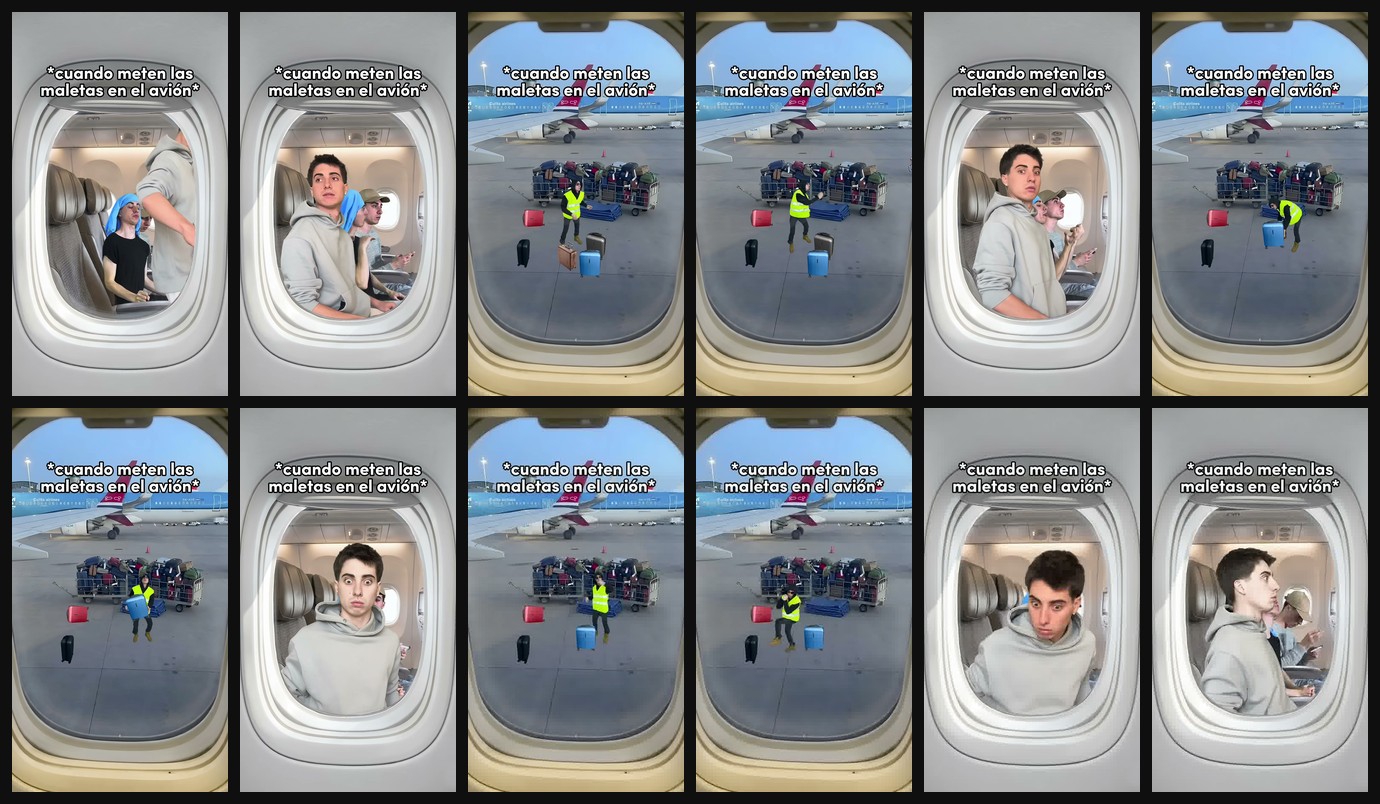
0-3 seconds
0-3s opening hook
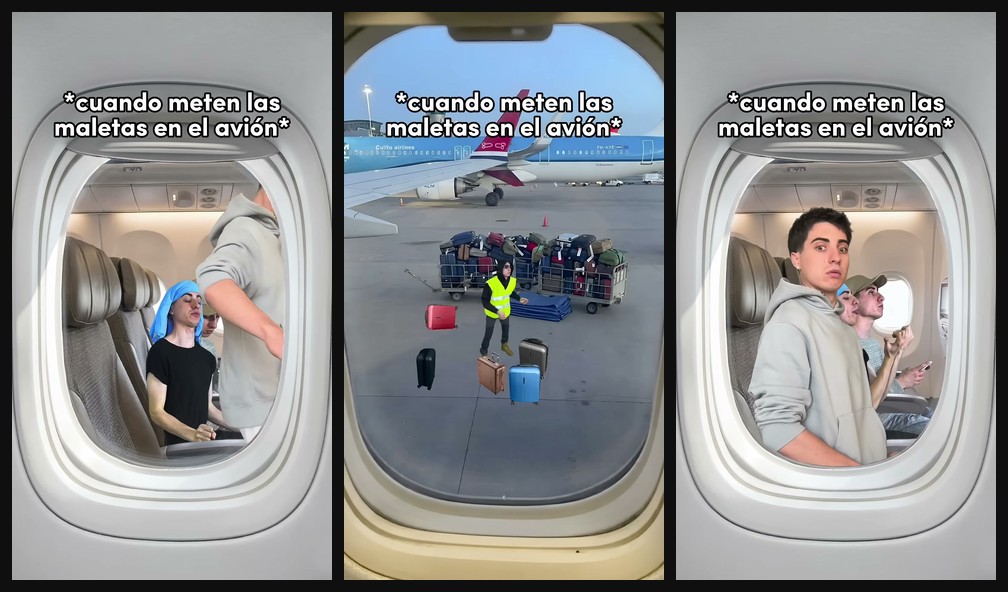
The strongest opening element is not conflict. It is a premise every air traveler understands immediately.
The Spanish caption says, in effect, 'when they load the luggage onto the plane,' and the window-seat framing instantly activates that shared anxiety.
This kind of hook has almost no comprehension cost. It does not need character setup or backstory.
Once the outside baggage chaos appears, viewers naturally stay to see how the passenger reacts.
Density
Viral density
Turning points
The airplane-window framing and Spanish caption establish the premise
The outside view first reveals the baggage worker and scattered suitcases
The main passenger turns and begins to panic
The outside baggage handling keeps escalating the absurdity
The passenger reaches a fully frozen reaction
The calm seatmates provide the final contrast
Core conflict
The protagonist's private thought, 'what if my luggage is being treated like that right now,' collides with the calm normality of everyone else in the cabin, while the outside baggage chaos keeps intensifying the fear.
Ending design
The video ends on the frozen face instead of showing consequences because the real product is not an event outcome. It is the instantly recognizable emotion of travel anxiety turning into comedy.
Edit density
High but single-threaded. Every cut does one job only: show the baggage chaos outside or show the passenger getting more alarmed inside.
Roles
Roles
Window-seat passenger
The emotional center of the clip. He does not drive action. He exists to perform the exact internal panic the audience is meant to feel.
Baggage loader
The functional outside-world character. The performance does not need nuance. Repeated rough handling is enough to push the premise harder.
Seatmates
The contrast support. Their calmness makes the protagonist's panic funnier and turns the reaction into a stronger meme.
Frame-by-frame
Frame-by-frame
00:00 - 00:03
The clip opens with the caption `*cuando meten las maletas en el avión*` placed over the airplane-window frame, while the cabin passenger is visible inside. The premise and the setting are understood immediately.
00:03 - 00:06
The camera cuts to the tarmac view with baggage carts, a worker, and loose suitcases. The visual instantly literalizes the fear that checked luggage is getting tossed around below.
00:06 - 00:09
Back inside the cabin, the main passenger turns to look out the window and visibly stiffens. This is where the audience's emotional proxy fully shifts onto his face.
00:09 - 00:12
The outside baggage action repeats, escalating the premise through another rough movement. By now the joke structure is clear, so each repeat increases absurdity rather than delivering new information.
00:12 - 00:15
The passenger's expression upgrades into a wide-eyed freeze. The reaction shot is brief, but it works fast because viewers project their own travel anxiety onto it.
00:15 - 00:18
The ending stays on his fully stunned face while the seatmates remain normal. That contrast closes the loop and finishes the joke without needing any extra explanation.
Visual language
Visual language
Airplane-window framingCabin natural lightDaytime tarmac exteriorReaction close-upInside-outside cutting
The clip does not rely on flashy camera movement. It turns the airplane window itself into a fixed storytelling device.
The interior shots provide the reaction while the exterior shots provide the source of anxiety, and each alternation reasserts the joke logic.
The window frame works as both a visual identifier and a POV anchor, making the audience imagine themselves in that exact seat.
Because the inside-outside switching is so direct, the pace feels sharp even without complex blocking.
The reaction close-up works better because the background passengers remain normal, giving the panic a clear contrast point.
Scene & props
Scene & props
Scene keywords
Airplane-window POVCabin seat rowDaytime tarmac viewBaggage cartsPre-departure cabin moment
Prop keywords
SuitcasesSafety vestAirplane window frameSpanish caption textPassenger reaction face
BGM
BGM
This clip depends mainly on shared premise and facial reaction, not on lyrical information.
Even if it only had ambient sound or a light background cue, the joke would still work because the humor is carried by what is seen and how the passenger reacts.
It behaves like a classic meme reaction structure, where audio supports rhythm but does not carry the main idea.
Dialogue / text
Dialogue & screen text
No fixed spoken dialogue
*cuando meten las maletas en el avión*
Meaning: when they load the luggage onto the plane
Audience
Audience
Shorts viewers who instantly relate to checked-luggage anxiety on flights
People who enjoy simple daily-life premises paired with exaggerated facial comedy
Spanish-speaking or travel-meme audiences who like low-friction POV reaction sketches
Viewers who respond quickly to airports, boarding, and baggage-handling anxiety jokes